Pricing Guides & Dictionary of Makers Marks for Antiques & Collectibles



APPRAISAL VALUES & MAKERS MARKS IDENTIFICATION
values4antiques - marks4ceramics - marks4silver
- Thousands of WORLDWIDE identification marks & hallmarks - COVERS ALL PERIODS and STYLES ✅
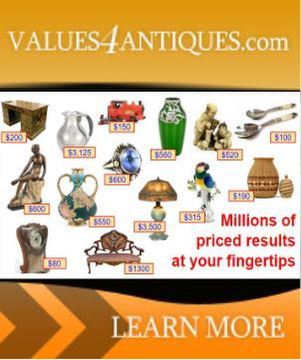
- Price Guides to appraise the value of ANY and ALL items - see popular examples ✅
- Fast & practical VISUAL dictionary of marks to compare authentic with fake marks instantly ✅
- Find marks easily by shape, name, initials, company, maker, studio or artisan ✅
- HELP GUARANTEED - see sample answers on Ceramics marks and Jewelry & Silver marks ✅
- UNLIMITED RESEARCH - CONSTANTLY UPDATED - ALWAYS AVAILABLE - see How it works ✅

Proper identification and authentication of your antiques or collectibles are essential in establishing a fair price for your treasures. Having first identified the makers marks, place of origin and age of your items makes it easier to research them further. Likewise, appraising and evaluating your items by finding similar examples that have actually sold, helps you determine their worth and gives you a better understanding of current market conditions.
In turn, this valuable information leads to better decisions when buying or selling and can prevent costly mistakes in paying too much or selling too low. It also helps in describing or listing your items using the correct terms to attract more buyers. And in the case of family heirlooms, it enables you to delve more deeply into their history.
Stemming from decades of personal experience in the field of antiques and by sharing the same concerns as our professional members, we have created convenient online practical research tools to assist you on a day-to-day basis:
- 1) Identification of makers' marks - includes quick visual reference guides to help you identify and recognize company &
artisan marks or backstamps for:
- Ceramics - including worldwide makers and company marks on Porcelain, Chinaware, Earthenware, Figurines, Vases, Porcelain Dolls, Stoneware, Majolica or Faience Pottery, Clayware, Art Ceramics & Studio Pottery and other related items of all styles and periods (16thC - Present)
- Metals - including domestic & international makers marks and hallmarks on Sterling Silver & Silver-plate, Jewelry & Costume or Fashion Accessories, Pewter & Tin, Silver-on-Copper, Britannia & Nickel Silver and many other metal alloys or precious metals of all styles and periods (14thC - Present)
- 2) Appraisal of Antiques & Collectibles - includes instant access to millions of actual auction records or results for ALL types and categories of items to help you evaluate your treasures. Quickly browse through photos of related examples to compare them to yours directly on your screen and print these records for your reference. No need to send photos or descriptions.
Our main marks identification reference guides display all images of marks of a similar shape on a single page and is super easy to use. It includes reproductions or fake marks on recent imports, which are shown side-by-side authentic ones for quick visual comparison. You can locate your porcelain or silver or jewelry marks by simply browsing similarly looking marks and instantly identify and date your items. For example, if your mark looks like an Anchor, you can browse through our ANCHORS page to find yours quickly and accurately. The same applies for marks that look like a Crown, or a Wreath, or begin with a Letter, or are marks with "foreign" characters such as in Russian or Chinese.
You can also search for makers marks or backstamps by using our proprietary NAME and INITIALS SEARCH tools. Our NAME SEARCH allows you to just enter the name of the company or artisan to view all related marks on one page along with a Fact Sheet with important information on their history, location, years of operation or main products. Our INITIALS SEARCH is particularly efficient when researching Silver or Jewelry marks which are made up of letters only. By entering these initials, this tool instantly displays a fresh new page with all images of marks or hallmarks that match these letters, even if they are conjoined, overlapping or intertwined. Anyone that has ever tried to research Silversmiths or Jewelers initials marks knows first-hand how useful such a research feature can be.
HELP GUARANTEED: Our guides to identify makers marks or backstamps and hallmarks are totally worry-free. As a member, you can send us questions if you cannot find your marks or have doubts at no extra charge. Our specialists are always on stand-by to share their knowledge and expertise. Answers are sent directly to you by email, not broadcast on a Forum, and are personal communications between you and our antiques experts. You can ask as many questions as you like and as often as you wish FOR FREE.
Our monthly or annual membership rates are flat and all-inclusive and you will not be required to pay any extra charges whatsoever at any time, regardless of how often or how much you use our services.
Our Antiques Values service provides a "smart" search tool to locate auction results and works like an intelligent Antiques Price Guide totally online. Thanks to today's computing power and lots of clever programming, it instantly checks the words you've entered against common terms used by real auctioneers and finds all related items. To make them useful, our antiques pricing reference databases include only items that have actually sold.
Once you enter a search, for example Stickley Table or Doulton Figurine or Taxco Silver or Steuben Crystal or Bronze Mantel Clock you will see numerous actual images of relevant results and then you can select which ones are similar to yours to print the page and keep for your records. This feature is particularly useful for professional Antiques Appraisers who need to collect "comps" for their evaluations.
There is no need to send photos or descriptions to anyone. No special apps to download and no extra computer skills are required. You get instant and accurate results right on your screen. The same applies for any type of search and the whole process of pricing or appraising your antiques or collectibles can be fun and efficient.
Our antiques or collectibles pricing reference databases are constantly updated with the latest auction results originating from hundreds of "real" auctions, not from online-only sales. These auction records are from live auctioneer sales located in the USA (60%), UK (30%), and Australia – Germany - France (10%) and provide for the right balance of accurate information to determine the worth of your items with actual prices, not estimates or abstract value ranges. All results include a full description of each item, a large clear image or picture, the name and location of the Auction House, the actual Hammer Price and when it sold.
Special features include the ability to view all results in actual images of relevant items. You can just browse and select as many items as you wish by adding them to our "Compare Box" to view them all on a new page with full details for comparing or printing. There are literally millions of actual and real auction results for all types of antiques or collectibles and our pricing reference library keeps growing all the time.